

September 3 2018 – Click here to listen
I was in Washington D.C. shortly after the Reverend Billy Graham died and viewed his casket as he was lying in state in the capitol rotunda. I was amazed at his casket. It was simply beautiful. I happened to notice something that looked out of place. I saw several names crudely carved into the wood of the casket. I read a story in the Charlotte Observer about how some inmates at Louisiana State Penitentiary built Rev. Billy Graham’s casket at the request of his son Franklin Graham.
Here is a shortened version of the article:
“They built it inside a small prison wood-working shop, tucked away from the main complex of America’s largest maximum-security penitentiary. The three men were inmates: Liggett and Bowman sentenced to life for murder, Krolowitz serving more than 30 years for armed robbery. The prison is formally named Louisiana State Penitentiary, but everyone calls it “Angola” – built on land that was a slave plantation, home to thousands of people who were forcibly taken from Angola, their birth country in Africa. Angola, with its 18,000-acre footprint in the Lower Mississippi Delta, houses men who have committed the most violent of crimes.
Hand crafted by
Richard Liggett
Paul Krolowitz
Clifford Bowman
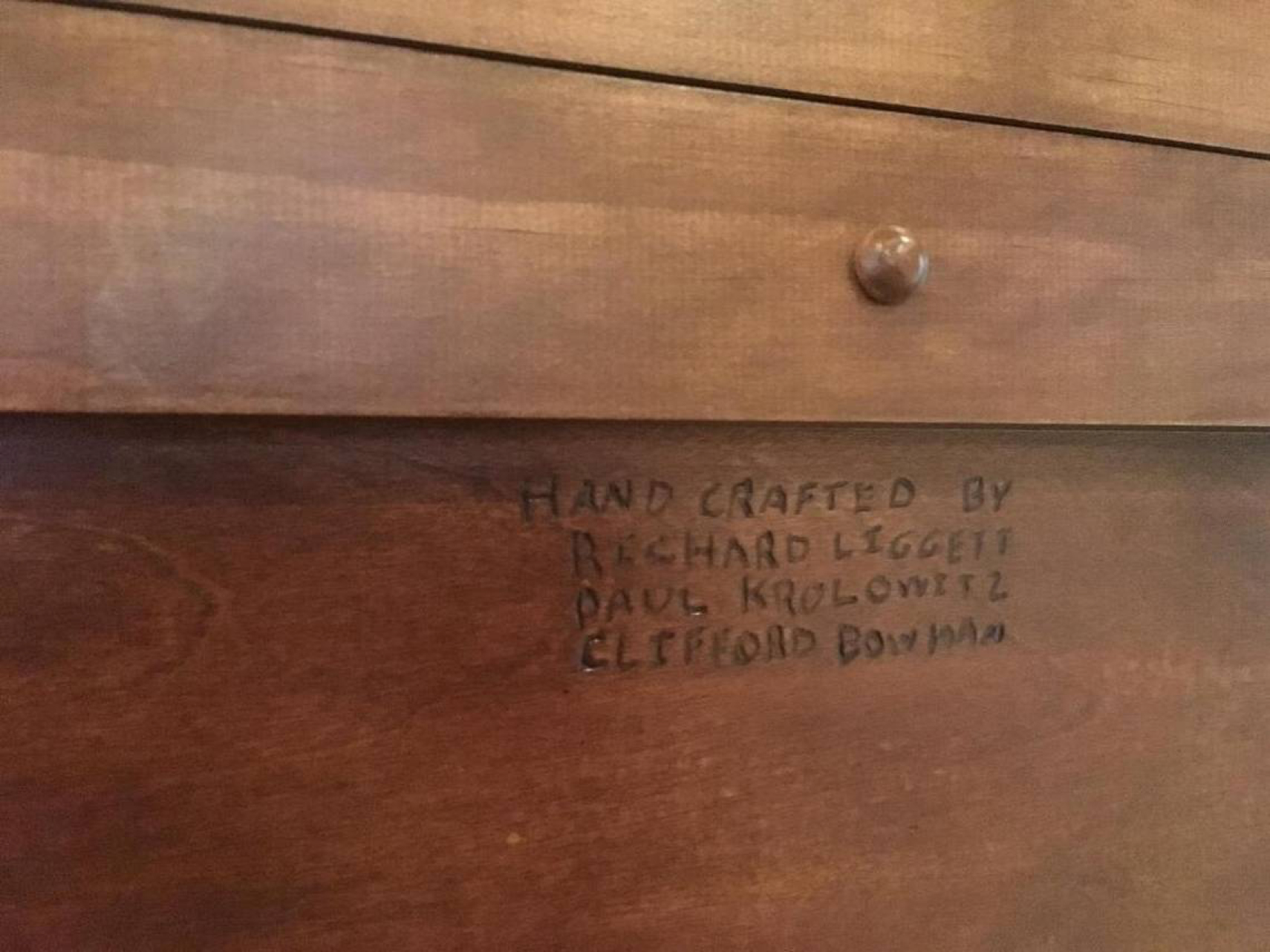
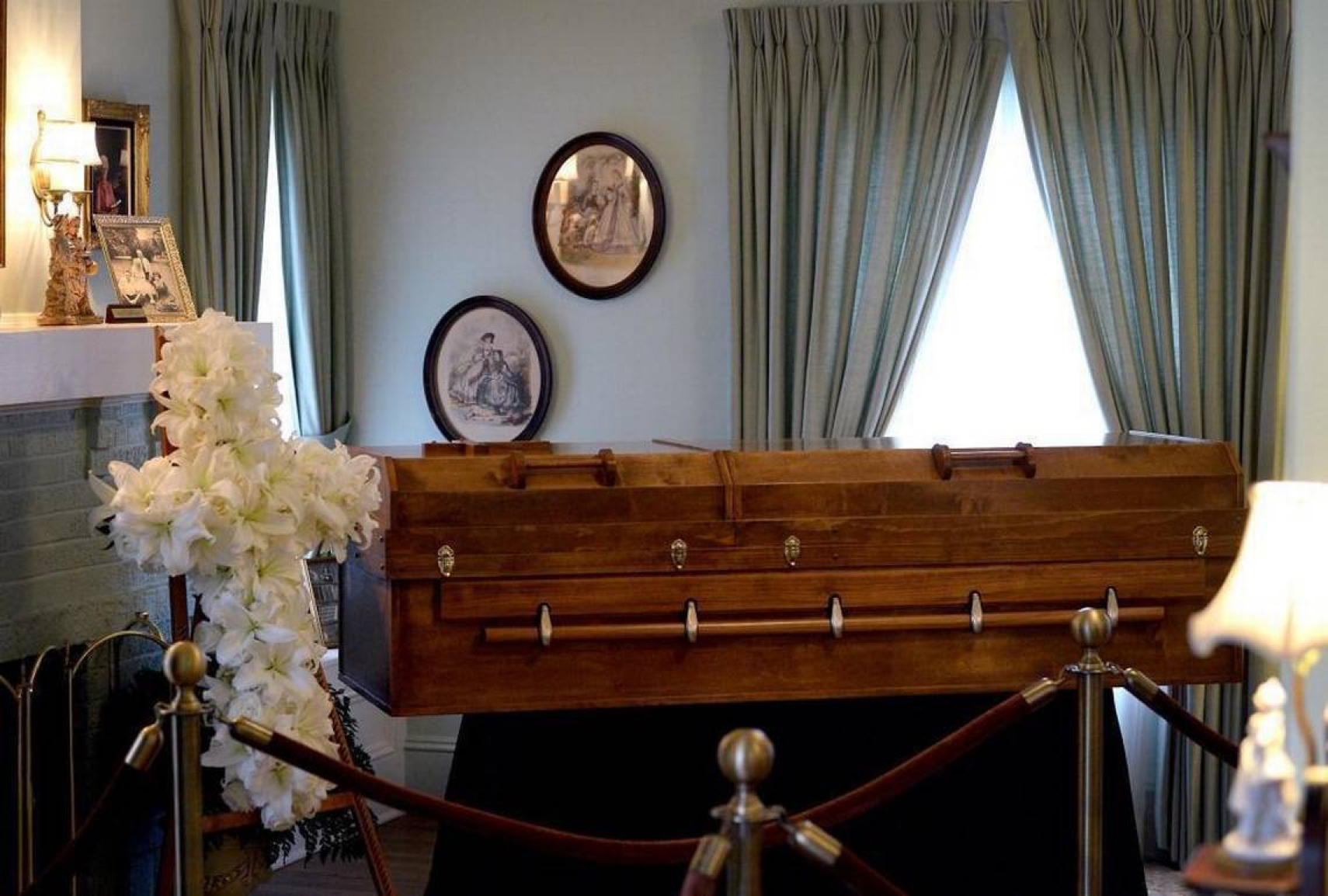
SLIDES © Courtesy Graham Gourley
Most of the more than 5,600 inmates will die behind bars – either serving a life sentence or by execution. In many cases, inmates’ families cannot afford to have their remains shipped or to pay for a funeral. For years, Angola buried these prisoners inside crate-like boxes, not much sturdier than cardboard. Sometimes, the home-made coffins fell apart. A new warden decided that wouldn’t do.
Dignity for the dead
A decade before Graham’s ministry reached Angola, the prison was considered one of the toughest, bloodiest jails in the country. Burl Cain, a new warden hired in 1995, is credited with expanding Angola’s education and work training programs. His “moral rehabilitation” philosophy called for inmates to work unless they were physically unable and to practice spirituality or religion. Cain himself chose Jesus. But, being a state-run facility, Angola had to welcome all religions…
Early in Cain’s tenure, he stood at the foot of a prisoner’s grave. He watched as inmates began to lower the coffin into the ground. But the box, with the man’s body inside, fell apart, remembers Gary Young, assistant warden at Angola who has worked at the prison for nearly 30 years. Young said Cain believed that prisoners who died at Angola had paid their debt to society and deserved a dignified funeral service and proper burial. Cain started a casket-building program at the prison – and he turned to an inmate known as “Grasshopper” to design a reliable casket.
A simple casket
One day Franklin Graham visited the facility. The Graham family has donated more than $200,000 to help build chapels and support prison ministry at Angola. When Cain opened the prison gates to preachers like Franklin Graham, the change among prisoners was evident, says Young. “Moral rehabilitation,” he said, is as much as about changing hearts for the good as it is teaching an Angola inmate a trade. The prison wanted to host Billy Graham but by the early 2000s, the evangelist was unable to make the trip. His son Franklin, though, visited several times. So did his daughter Ruth.
A tour of Angola in 2005 took Franklin Graham to the woodworking shop, where he was moved by the simple dignity of the caskets and the inmates’ care in building them. According to Young, who was on the tour that day, Franklin said his father was a “simple man with a simple message,” and would want to be laid to rest in a simple casket. Franklin Graham asked Cain to have Angola carpenters make a casket for his mother, Ruth Bell Graham, and his father, and to burn the builders’ names into the wood. The cost: $215 each. He declined Cain’s offer to use a higher-grade wood for the Grahams.
Ruth Bell Graham died in June 2007 and was buried in one of the Angola caskets. Richard Liggett didn’t get to see the family receive the casket he’d built for her, or to see her funeral – he died three months earlier from lung and liver cancer. Prison officials shipped Liggett’s body to his family in Kansas. They sent with him a casket – one of the last ones Liggett had built before he was too sick to work in the shop. John Liggett believes his brother’s heart was changed at Angola because he went to church and heard a tale of redemption.
In a box of papers, discovered at their mother’s house after Richard Liggett died, his brother found dozens of certificates from Angola. The papers show Liggett was active in church, studied the Bible and shared his religious views with other inmates. “My brother,” he said, “was probably saved by Billy Graham.”
‘The love of God’
As Liggett’s health declined in 2005 and 2006, other inmates were brought in to help build the caskets. At least four other inmates, whose names aren’t on Billy Graham’s casket, had a hand in building it, said Young, the assistant warden. David Bacon, convicted of murder in 1988 and sent to Angola to serve a life sentence, was one of them. Bacon told the Observer he grew up estranged from his stepfather and mother. He didn’t know his biological father until he was 12.
“This comes from hindsight: I was looking for love, guidance, acceptance, approval,” Bacon said. “When you’re young, you’ll do anything to get it. I couldn’t get that from my father.” Instead, Bacon filled his life with drugs and alcohol, he said. By age 24, he had no job and his wife had left him, taking their two young daughters. In 1988, Bacon and his stepfather killed a man in Baton Rouge, according to court documents.
At Angola, he entered substance abuse counseling and Alcoholics Anonymous. He earned his GED, took public speaking courses and participated in anger management classes. Prison was the unlikely place he found faith, Bacon said. “I had never really had a relationship with God or Jesus,” Bacon said. “But after a few years at Angola, I began to soul-search and make those changes.” In Billy Graham’s preaching, Bacon heard a message of redemption, he said, and his newfound faith filled a hole in his heart he had barely realized was there. Graham’s teachings, Bacon said, showed him God wasn’t looking down at him inside Angola with judgment. “They showed us the love of God,” Bacon said. “Nobody is beyond redemption. I’ve been redeemed.”
Bacon was awarded clemency and released from Angola in December 2016. He lives in Mississippi and says he’s established relationships with his brother, his two daughters – now 34 and 31 – and four grandchildren. He has a job remodeling homes and says he’s been thinking about trying to build caskets again. On Wednesday, he watched television coverage of Graham lying in honor in the U.S. Capitol. Bacon remembers the smoothness of the cabinet-grade plywood and the smell of the wood stain as he helped build Billy Graham’s casket. “It was,” he says, “a great honor and a privilege.”
Anna Douglas (Maria David contributed.) Visit The Charlotte Observer (Charlotte, N.C.) at www.charlotteobserver.com
Interestingly I was always afraid I would end up in Angola. My life of crime in New Orleans nearly sent me there when it was the bloodiest prison in the United States. I have little doubt that I would have ended up dead had I ended up there. Like those inmates who built the casket, Jesus transformed my life.
I would like to point out that the reverend Billy Graham’s eternal home is not in that pine box, but in heaven. He was a simple humble man with a simple message: God loves you and wants to save you. He will take you just as you are. Interestingly those prisoners will join Billy in heaven even though at one time they were considered the worst of the worst. Billy understood that the grace of God is extended to every person on this planet. Jesus doesn’t look at us as to what we are now, but what we can be with Him helping us if only we ask for that help. Ask today . . . Selah . . .
James 2:1
My brothers, show no partiality as you hold the faith in our Lord Jesus Christ, the Lord of glory. For if a man wearing a gold ring and fine clothing comes into your assembly, and a poor man in shabby clothing also comes in, and if you pay attention to the one who wears the fine clothing and say, “You sit here in a good place,” while you say to the poor man, “You stand over there,” or, “Sit down at my feet,” have you not then made distinctions among yourselves and become judges with evil thoughts? Listen, my beloved brothers, has not God chosen those who are poor in the world to be rich in faith and heirs of the kingdom, which he has promised to those who love him? . . .